This project demonstrates the audit itself, not an ongoing SEO campaign. The first audit found launch, trust and search-readiness gaps. The action plan converted them into ordered tasks. Later audits checked the fixes, exposed new issues created by the expanded website and produced the next implementation sequence.
The project story
Website created
A new fixed-price SEO-audit website was built with a clear €299 Audit and €599 Foundation offer.
First audit
The 1 October audit scored 62/100 and found legal placeholders, duplicate homepage URLs, missing canonicals, no sitemap, no schema and weak identity/proof signals.
Action plan
Findings were assigned P0–P3 priorities, owners, effort estimates and acceptance criteria.
Priority fixes implemented
Technical consolidation, business identity, privacy content, evidence pages, schema, social previews and crawl-control files were added.
Re-audits
The 4 October score reached 85/100. The 6 October audit reached 88/100 and found the next issues: content depth, schema coverage, workbook headers and intermittent hosting behavior.
Launch roadmap
Previously fixed items were verified, remaining work was separated from evidence-dependent or hosting-only tasks, and a clear release order remained.
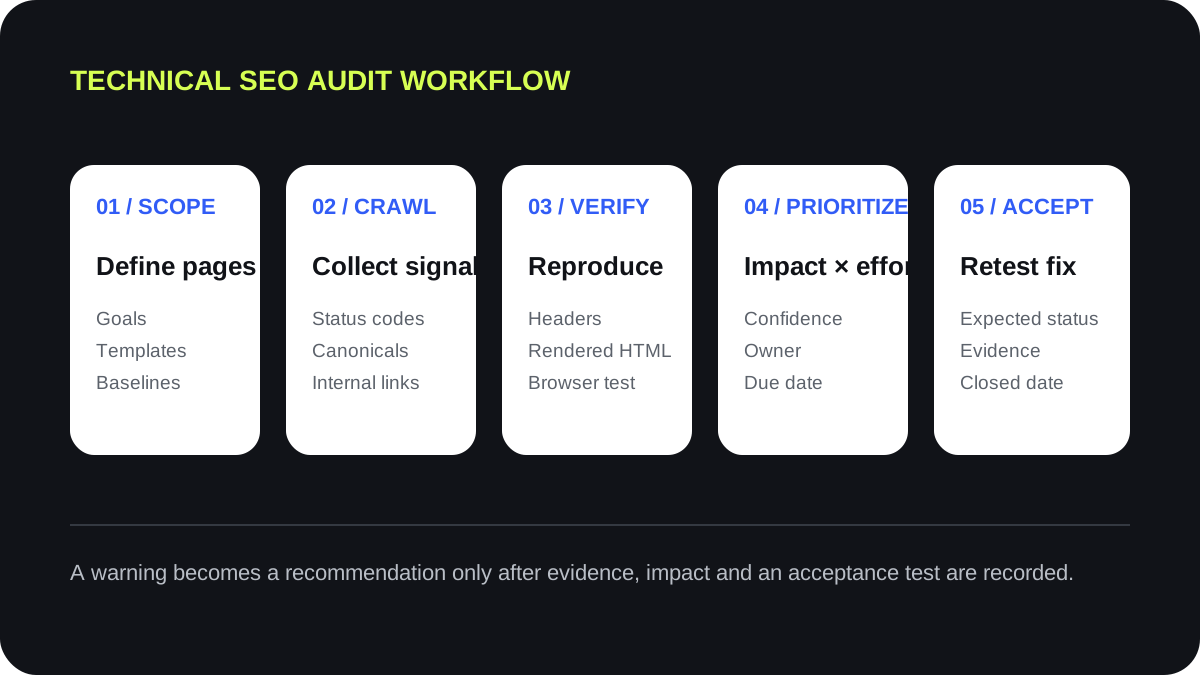
What did the audits inspect?
The project was reviewed as a search and enquiry system, not just a collection of title tags. Each area contributed different evidence to the roadmap.
Technical SEO
Crawlability, status codes, canonicals, redirects, HTTPS, headers, JavaScript rendering and URL consolidation.
On-page SEO
Titles, descriptions, H1–H3 structure, page targeting, internal links, anchors and search-intent alignment.
Content & trust
Provider identity, auditor expertise, contact paths, privacy information, case evidence, methodology and claim support.
Structured data
Organization, Person, WebSite, WebPage, Service, Offer and later page-specific Article or profile entities.
Performance
Repeated mobile and desktop LCP/CLS observations, TTFB, asset weight, CSS/JavaScript growth and measurement limits.
Images & social
Social-card availability, dimensions, weight, alt descriptions and later purposeful in-page visual assets.
Discovery controls
robots.txt, XML sitemap, noindex behavior, canonical URLs, language alternatives and genuine 404 behavior.
AI search readiness
Entity clarity, answerable passages, author/source signals, llms.txt, AI crawler responses and citation limitations.
Mobile & visual UX
Above-fold clarity, touch targets, horizontal overflow, reveal behavior, direct fragment links and responsive layout.
SXO & conversion
Offer clarity, pricing, navigation, trust near decisions, privacy acknowledgement, form usability and enquiry flow.
P0: complete before accepting more enquiries
P0 was reserved for business-critical issues that could undermine trust, privacy or the ability to receive a lead. These came before content expansion or authority building.
| Priority | Finding | Required action | Acceptance criteria |
|---|---|---|---|
| P0 | Privacy information contained template placeholders and launch instructions while the form collected personal data. | Replace temporary content with accurate controller, processor, retention, rights, complaint and international-transfer information. | Correct controller identity, monitored privacy email, processors, retention, rights/complaint route and transfer wording are live. |
| P0 | The service provider and person performing the audit were not clearly identified. | Identify the operator and auditor close to the service and conversion decision. | Legal/brand name, named auditor, role, contact email, operating city/country and a usable contact path are visible. |
| P0 | The real enquiry flow needed production verification. | Submit and trace a genuine test enquiry through success, failure and privacy-acknowledgement states. | The enquiry arrives; success/error states work; acknowledgement is recorded; values do not leak into URLs; the privacy link stays visible. |
Status: privacy and provider identity were fixed and rechecked. The website files implement the form states and privacy acknowledgement; real production mail delivery remains an owner verification because the audits did not submit a live enquiry.
Eight examples of actionable guidance
Each example is written so a developer, writer, designer or marketer can act without interpreting a raw crawler export.
Duplicate homepage variants diluted consolidation signals
- Finding
- The root, HTTPS www and
/index.htmlvariants returned identical 200 pages without a canonical. - Why it matters
- Search engines and internal links could treat several URLs as separate versions of the same homepage.
- What to do
- Choose
https://measureseo.lt/as the canonical homepage; permanently redirect www and index-file variants; add a self-referencing canonical. - Acceptance criteria
- Each alternate resolves to the canonical destination without a loop; the canonical page returns 200; internal links use the destination directly.
Re-audit: HTTPS variants and index-file consolidation passed; internal redirected targets later fell to zero. The upstream HTTP www path still requires a one-hop Hostinger/CDN rule.
No XML sitemap or declared discovery path
- Finding
- The initial site exposed only two substantive pages and common sitemap paths returned 404. robots.txt did not declare a sitemap.
- Why it matters
- A new site needs a clean inventory of canonical pages so crawlers can discover the intended URLs efficiently.
- What to do
- Publish an XML sitemap containing only canonical, indexable 200-status URLs and add its absolute URL to robots.txt.
- Acceptance criteria
- The sitemap returns valid XML/200; every listed URL is canonical and indexable; robots.txt contains the absolute sitemap URL.
Re-audit: coverage grew to 16 and then 24 URLs; every audited sitemap URL initially returned 200 and self-canonicalized.
Structured data was entirely missing
- Finding
- The first audit detected no JSON-LD, Microdata or RDFa.
- Why it matters
- The service, prices, provider and page relationships were visible to people but not expressed as machine-readable entities.
- What to do
- Add a truthful Organization, Person, WebSite, WebPage, Service and Offer graph matching visible facts. Later add page-appropriate Article, ProfilePage and CollectionPage markup.
- Acceptance criteria
- JSON parses in initial HTML; absolute IDs are reused consistently; every claim matches visible content; no unsupported ratings or reviews are added.
Re-audit: homepage schema reached 90/100 in the 4 October category review. Expansion later exposed a coverage denominator gap, which was addressed across all 24 public pages in the implementation package.
The homepage targeted the offer, but not the strongest commercial wording
- Finding
- The exact phrase “SEO audit” appeared in metadata but not naturally in the H1 or early rendered copy. Broad “SEO audit” results were also tool-heavy.
- Why it matters
- The page needed to communicate a human fixed-price service, not compete as a free scanner or generic definition.
- What to do
- Use the service-led title “Fixed-Price SEO Audit Service | Prioritized 90-Day Plan,” an H1 containing “fixed-price SEO audit,” and separate broad educational intent into a guide.
- Acceptance criteria
- The commercial page clearly states service, price logic and output; a separate guide serves informational intent without duplicating sales copy.
Re-audit: commercial and informational page types were separated and on-page SEO improved from 68 to 93, then 95.
Trust advice became a precise provider-identity requirement
- Finding
- The original service was anonymous: no named auditor, biography, contact email, operating location or clear editorial responsibility.
- Why it matters
- A buyer could not verify who would receive their data or perform a professional audit.
- What to do
- Publish the operator name, auditor name and role, monitored email, operating city/country, working principles, About page and visible responsibility for the audit.
- Acceptance criteria
- The identity information is visible in the service journey and consistent with Organization/Person structured data.
Re-audit: the provider identity and About resources were present. Unsupported credentials, ratings, profiles and testimonials were deliberately not invented.
Direct mobile links to the enquiry form stopped near pricing
- Finding
- A direct or refreshed mobile visit to
/#startdid not settle on the form, while clicking the visible CTA eventually arrived after a long smooth scroll. - Why it matters
- Campaign links, copied URLs and returning users could miss the conversion target even though the page appeared functional.
- What to do
- After layout initialization, detect the hash and reposition the target without prolonged smooth scrolling. Respect reduced motion.
- Acceptance criteria
- Direct load, refresh, back/forward and reduced-motion visits place the form below the sticky header at mobile width.
Re-audit: both direct and clicked mobile journeys reached the form target with no horizontal overflow.
A single slow mobile run did not justify rebuilding the site
- Finding
- The 4 October mobile runs were 1.712 s, 1.884 s and 4.904 s LCP; median 1.884 s, CLS 0. Desktop median was 0.256 s.
- Why it matters
- One poor lab outlier can signal instability, but it is not field Core Web Vitals evidence.
- What to do
- Repeat the same test profile, capture a trace for LCP above 2.5 s, preserve the no-third-party-script discipline and wait for CrUX/Search Console field evidence before architectural changes.
- Acceptance criteria
- A repeatable sample shows a stable median and identifies any recurring slow trace; field LCP, INP and CLS are assessed when eligible.
Re-audit: the 6 October mobile median improved to 1.024 s, desktop to 0.208 s and CLS remained 0. INP and real-user data were still unavailable.
The useful Excel template was served as plain text
- Finding
- The workbook was valid and downloaded in Chromium, but the server returned
text/plain,nosniffand no attachment filename. - Why it matters
- Some browsers or clients can refuse or mishandle a valid file when its response headers contradict the format.
- What to do
- Set the official XLSX MIME type and
Content-Dispositionfilename while preserving security headers. - Acceptance criteria
- A deployed HEAD request returns the official Excel MIME type and intended filename; the downloaded workbook opens successfully.
Status: the Hostinger package contains the header configuration. Final acceptance requires checking the deployed response because hosting must honor the rule.
How priorities prevented a 100-item dead end
Before enquiries
Privacy, identity and real lead-flow risks.
First 7 days
Consolidation, discovery, schema, targeting and proof.
Days 8–30
Supporting content, mobile polish, methodology and evidence depth.
Days 31–90
Measurement, authority, monitoring and longer-term expansion.
Why was MeasureSEO audited more than once?
A website changes when recommendations are implemented. The first audit found launch blockers. The next audit verified those fixes and detected problems that did not exist—or were not material—when the site had only two pages. The final rerun evaluated a 24-page content system, download delivery and crawl behavior.
Legal placeholders, duplicate homepage URLs, missing canonicals/sitemap/schema, weak identity and no case proof.
Critical launch items materially fixed; new mobile deep-link, social-image, page-schema and case-verification issues identified.
24 canonical pages, faster stable lab performance and fixed deep links; new content-depth, schema-coverage, file-header and hosting-rate issues exposed.
A €299 audit does not imply unlimited re-audits. These iterations document the development of MeasureSEO's own website. They demonstrate why verification is valuable when a site changes.
What does the €299 SEO Audit actually deliver?
- Executive audit summary
- Technical crawlability and indexability review
- robots.txt, sitemap, canonical and URL review
- On-page metadata, heading and targeting analysis
- Internal-link and anchor review
- Content quality, E-E-A-T and trust review
- Structured-data review
- Core Web Vitals mechanics and performance review
- Image and social-preview review
- Mobile and visual inspection
- GEO and AI-search readiness review
- SXO and conversion-path review
- Search Console evidence when access/data exists
- Prioritized P0/P1/P2/P3 action plan
- Concrete implementation instructions
- Acceptance criteria and recommended order
The output is a diagnosis and roadmap. It explains which work deserves attention first and which apparent warnings do not justify immediate action.
Audit, Foundation and Growth are different products
SEO Audit
Diagnose and plan.Find, verify and prioritize problems. Explain what should change and how completion is tested. Implementation is not included.
SEO Foundation
Diagnose + implement priority fixes.Includes the audit, then implements the agreed high-priority on-site changes where access and scope allow.
SEO Growth
Execute and improve continuously.Recurring optimization, content expansion, keyword work, competitor analysis, monitoring and authority development.
The result: a website with a prioritized launch roadmap
The combined audits converted a newly built website into a clearly documented SEO project. The value was not a generic instruction to “improve SEO.” It was an ordered record of what was observed, why it mattered, who should handle it, what to change and what evidence proves the work is complete.
Want the same level of clarity for your website?
Get a comprehensive SEO Audit that identifies what is holding your website back, prioritizes the issues and gives you a clear roadmap for what to fix first.
SEO Audit — €299Get My SEO AuditIf you want Measure SEO to implement the agreed priority fixes after the audit, you can choose SEO Foundation — €599 under the current offer terms.